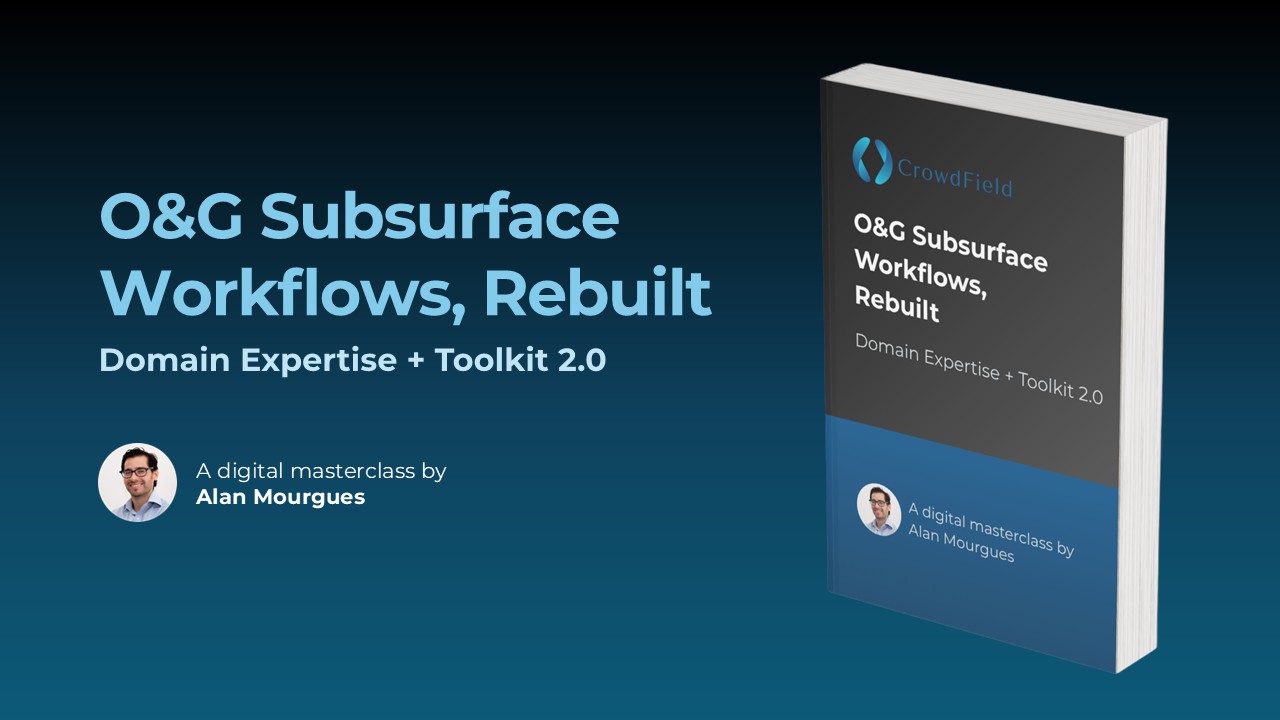
CrowdField Masterclass

Domain Expertise + Toolkit 2.0

AI, Python, web apps, automations, and workflow systems for modern O&G technical practitioners.

Founding Cohort — 20 seats only

O&G Subsurface Workflows, Rebuilt

Across the full modern stack

Most Oil & Gas subsurface workflows haven't changed in a decade, but the tools available to technical professionals have evolved dramatically.
AI, Python, automation, web apps, deployment tools, and interactive workflows are rapidly reshaping how technical work gets done.
This masterclass shows, step by step, how to draw from the modern stack and apply the right combination of tools to redesign real subsurface workflows for the modern era and future-proof the way you work.

Technologies we draw from
Excel VBA Power Query Python AI Claude Codex GitHub Streamlit Automation Web Apps Deployment No-Code

Not a course about any one of these. A masterclass in knowing when and how to reach for each.

Join the Founding Cohort — $299

Public release price: $499–$799. Limited to 20 participants.

Format
4 recorded sessions
One hour each. Structured, practical, workflow-driven.
No coding required
Zero prior experience needed
You don't need to be a developer. You bring the technical expertise.
Materials
Full source code + workbooks
Everything you need to follow along and apply immediately.
Access
Immediate + future versions
Early access now, plus the finalized public release and all refinements.
The Real Bottleneck

Your workflows are a decade behind the tools available to you

Most subsurface professionals still run the same manual routines built 10–20 years ago. The tools have changed dramatically. The workflows haven't.

  • Copy-paste routines across disconnected spreadsheets
  • Manual data cleaning repeated every time
  • Excel files that break when someone else touches them
  • Reports assembled by hand from multiple sources
  • Workflows only you can run, because only you understands them
  • No version control. No reusability. No scale.

A new layer of technology is now practical and accessible: Python, AI assistants, cloud deployment, web apps, automation pipelines. None of it requires a computer science degree.

The barrier is no longer access to technology. It is knowing when to use each tool, how they fit together, and how to integrate them into the workflows you already run every day.

This masterclass is about workflow orchestration. Not mastering a single tool, but learning how to combine the modern stack to build workflows that are faster, cleaner, more scalable, and easier to maintain.

What this is

Workflows first. Tools second.

Every tool in this masterclass is introduced at the moment a real workflow demands it, not as technology to study in isolation.

This is not

Generic tool-first training

  • A Python or coding bootcamp
  • A generic AI tools webinar
  • A collection of Excel tips and tricks
  • Abstract digital transformation theory
  • Training designed for developers or coding experts

This is

Real technical workflows, modernised

  • Tools introduced when a workflow demands them
  • AI used to generate, explain, and adapt code
  • Automation built without starting from scratch
  • Interactive web apps deployed step by step
  • Practical systems you can apply immediately

You do not need to know how to code

This masterclass is designed for practitioners who understand the work but want to modernise how the work gets done. You will learn how to use AI, Python, GitHub, automation tools, and deployment platforms as practical workflow enablers, without needing a software engineering background. That is precisely the point. The goal is to help you build faster, smarter, more scalable workflows using the modern stack now available to technical professionals, without turning you into a programmer.

The approach

Real workflows. The full modern stack.

We draw from a range of real subsurface workflows familiar to technical professionals across the industry, then progressively modernise them by layering in tools from the broader modern stack as each workflow demands it.

The exact workflow mix will evolve during the founding cohort based on participant feedback, workflow interest, and the areas generating the most practical value.

Workflows we may explore
  • Decline curve analysis
  • Relative permeability curves
  • PVT correlations
  • Monte Carlo volumetrics
  • RFT and MDT pressure plots
  • Inflow performance calculations
  • Production data processing and visualisation
  • Engineering reporting and decision support


The founding cohort is intentionally flexible. As discussions evolve and participants surface real workflow pain points, the scope and emphasis of the masterclass will evolve with it.

Tools introduced across these workflows

Each tool enters when a workflow outgrows what came before it.

Excel + Power Query
Structured workbook design and automated data pipelines.
ExcelPower Query
VBA automation
Repetitive operations automated. Workflows that run themselves.
VBA
Python scripting
Calculation engines and data processing, written with AI assistance.
Python
AI tools
Code generation and workflow design. No prior coding required.
AIClaudeCodex
Web apps
Interactive tools colleagues can use from a browser without touching code.
StreamlitWeb Apps
Cloud deployment + GitHub
Version-controlled, shareable tools deployed without a developer.
GitHubDeployment
No-code tools
Where they add the most value. Hybrid approaches alongside scripted components.
No-Code
Masterclass sessions

Four sessions. Four layers of capability.

Each session builds on the last, moving from structured spreadsheet workflows through to scalable, deployed engineering applications using the modern technical stack.

Session 01

Structured Workflow Design

What makes a workflow scalable instead of fragile. Rebuilding spreadsheet architecture from the ground up using structured workbook design, Power Query pipelines, VBA automation, and workflow-first thinking before tool selection.

Excel Power Query VBA
Session 02

Python Workflows With AI Assistance

Using AI assistants to generate, explain, debug, and adapt Python code. Translating spreadsheet logic into reusable workflows and calculation engines without requiring a software development background.

Python AI Claude Codex
Session 03

Interactive Engineering Applications

Transforming engineering workflows into interactive web applications with live charts, parameter controls, automated outputs, and browser-based interfaces that others can use without touching code.

Streamlit Web Apps No-Code
Session 04

Deployment, GitHub & Scalable Systems

Version control, deployment, and modern workflow distribution. Building engineering tools that are shareable, reusable, maintainable, and no longer trapped inside isolated local spreadsheets.

GitHub Deployment
Who this is for

Built for subsurface professionals who want to upskill

Designed for reservoir engineers and subsurface professionals who want to modernise the way they work and stay relevant as the modern technical stack reshapes the industry.

  • Your workflows are still too manual You spend real time every week on repetitive tasks that should already be automated, structured, reusable, or deployable.
  • You've heard of Python and AI but haven't made the leap AI, Python, automation, interactive web apps, and deployment tools are rapidly entering technical workflows across industries. You know this wave matters, but the practical entry point has never been clear.
  • You want practical capability, not hype No abstract digital transformation talk. No generic AI demos. Real workflows modernised using tools that exist and are usable today.
  • You want to build tools others can use Interactive applications, reusable workflows, browser-based tools, and scalable systems without needing a software development team behind you.
  • You do not want to become a a software engineer You want leverage, capability, and workflow modernisation while staying grounded in technical practice and domain expertise.

"The future will belong to technical professionals who can combine domain expertise with the modern workflow stack. AI, Python, automation, deployment, and interactive applications are becoming part of how technical work gets done. The professionals who learn how to integrate these capabilities into their workflows will have a major advantage moving forward."


Technical expertise alone is no longer the differentiator.

The differentiator is the ability to transform expertise into scalable workflows, reusable tools, interactive applications, and systems that create leverage far beyond manual effort.

This masterclass is about learning how to make that shift.

FAQ

Frequently asked questions

If you still have questions after reading through these, feel free to reach out directly.

No. This masterclass is specifically designed for technical professionals with little or no coding background. The focus is not on becoming a software developer. The focus is on learning how to apply AI, Python, automation, deployment tools, and modern workflow systems inside workflows you already understand.
A working knowledge of subsurface engineering is the only prerequisite. You should already be familiar with at least some of the workflows discussed, such as decline curve analysis, PVT, volumetrics, production data analysis, or similar technical workflows. No Python, GitHub, or prior automation experience is required.
Yes. Everything in the masterclass is built around practical implementation. Every session includes working files, source code, workflow templates, and examples designed to be adapted directly into your own work. Founding cohort members also receive updated materials as the masterclass evolves.
You receive early access to all four recorded sessions as they are released, along with all supporting files, VBA code, Python workflows, web app examples, and deployment walkthroughs. You also receive access to the finalized public release version, and your feedback helps shape the final scope and workflow emphasis of the masterclass. The founding cohort price of $299 will not be available at public release, planned at $499 to $799.
The masterclass itself is delivered as recorded sessions so the material remains structured, polished, and easy to revisit at your own pace. Alongside it, a separate live webinar series explores selected workflow examples with live Q&A and discussion. Founding cohort members will have access to both.
Possibly. While the masterclass is designed primarily for professionals earlier in their workflow modernisation journey, more advanced users may still find value in the workflow architecture, AI-assisted development approach, deployment workflows, application design concepts, and broader systems thinking covered throughout the sessions.
Sessions draw from a range of representative subsurface workflows including decline curve analysis, PVT, relative permeability, Monte Carlo volumetrics, RFT/MDT interpretation, Darcy flow calculations, production data processing, and engineering reporting workflows. The exact mix may evolve during the founding cohort based on participant feedback and which examples best demonstrate each layer of the modern workflow stack.
Generic courses teach tools in isolation. This masterclass uses real subsurface workflows as the backbone, so each tool is introduced inside a workflow you already understand. You learn Python through a decline curve workflow. You use AI to build automation around real engineering tasks. You deploy applications because the workflow demands it. The learning is practical, integrated, and workflow driven.
AI is changing how technical work gets done, but domain expertise remains the foundation. The professionals who benefit most from this shift will be those who can combine technical judgement with modern workflow capability. This masterclass is designed to help practitioners integrate AI, automation, Python, and deployment tools into workflows they already understand, rather than treating these technologies as something separate from technical practice.
Founding cohort

First access. Limited to 20 participants.

The masterclass is launching first as a limited founding cohort. Participants receive early access to each session as it is released and help shape the final workflow emphasis, examples, and supporting materials before broader public release.

Founding Cohort Access
$299
Public release planned at $499–$799
Limited to 20 seats
Join the Founding Cohort →

Founding cohort participants also receive access to the finalized public release version and all future refinements during the cohort phase.

What's included
  • All 4 recorded masterclass sessions
  • Example workbooks and engineering datasets
  • All VBA and Python source code
  • Power Query workflow examples
  • Streamlit application examples
  • GitHub project structures and templates
  • Cloud deployment walkthroughs
  • Access to the finalized public release version
  • All updates during the refinement period
  • Direct influence on workflow emphasis and scope

Built by a practitioner

Alan Mourgues

Reservoir Engineer | O&G Consultant | Founder @ CrowdField
  • done 20+ years in reservoir engineering across operators and consulting
  • done Founder of CrowdField, focused on practical subsurface workflows
  • done Author of "The dAIgest" newsletter on AI in O&G
  • done Host of the O&G Expert webinar series
  • done Host of the AI "Builders, Agents & Workflows" podcast
With over 20 years in the international Oil & Gas industry, Alan has worked across operators, advisory groups, and independent consulting.

His work sits at the intersection of engineering practice and modern tooling: Excel/PQ/VBA, Python, AI-assisted development, automation, and cloud deployment.

Not a software developer who learned engineering, but an engineer who learned how to build systems. That distinction shapes the practical, workflow-first approach behind this masterclass.

The tools exist. The workflows need to catch up.

You do not need to become a developer to work like one. This masterclass shows how domain expertise and the modern toolkit finally come together.

Join the Founding Cohort →

Founding cohort access is limited to 20 participants.